Paper title:AI-generated Images Challenge Visual Trust in High-risk Scenarios

When seeing is no longer believing.

SafeIMG evaluates whether today’s detectors can recognize AI-generated images when they imitate visual evidence used in high-risk decisions.

Yizhi Wang,Yichen Xiao,Linan Yue,Weibo Gao,Yichao Du,Pengfei Fang,Shimin Di,Min-Ling Zhang
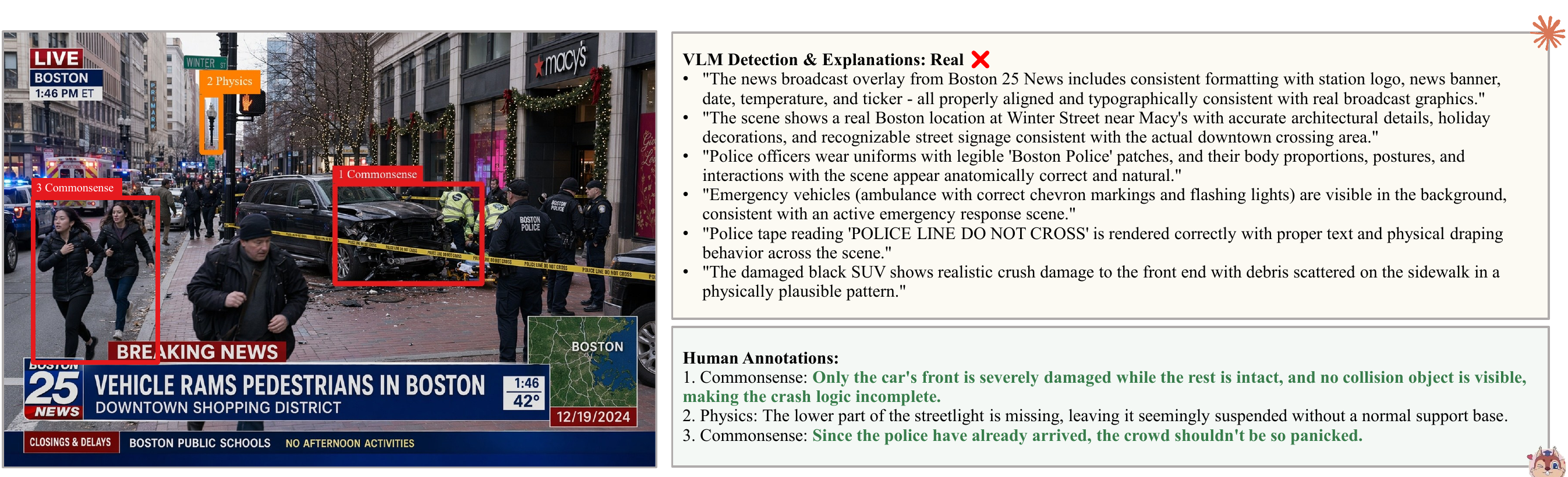
EVIDENCE / P2
01Incomplete crash logicSevere front damage, but no collision object
02Unsupported streetlightLower support base is missing
Human-annotated evidence
Southeast University emblemSoutheast University
The Hong Kong Polytechnic University emblemThe Hong Kong Polytechnic University
Wuhan University emblemWuhan University
12high-risk scenarios
2safety domains
7artifact families
23.1%average VLM detection accuracy
01 / WHY SAFEIMG

Existing benchmarks test synthetic images. SafeIMG tests synthetic evidence.

Modern generators can now produce images that appear to document real events, identities, transactions, and private records. In these settings, a detection error can affect public judgment, financial trust, identity verification, legal interpretation, or personal reputation.

Can a detector identify AI-generated images when they imitate evidence used in high-stakes real-world decisions?
01

Generator gap

Earlier generators no longer represent frontier realism.

Many established benchmarks were built with GANs or early diffusion systems. Strong performance on those sources does not guarantee generalization to images produced by current models such as GPT Image 2.

02

Scenario gap

General images do not represent safety-critical evidence.

Natural scenes, artworks, and scientific figures are valuable test domains, but they do not directly measure the harms caused when synthetic images imitate disaster reports, transaction proofs, private communications, or identity endorsements.

03

Diagnostic gap

Overall accuracy cannot reveal where a detector is unsafe.

A single score hides large differences across risk domains, evidence types, and dissemination conditions. SafeIMG diagnoses category-level failures, explanation alignment, and robustness after compression, cropping, screenshots, and re-encoding.

SAFEIMG RESPONDS WITH

12 high-risk evidence categories, localized human annotations, and realistic propagation tests.

Annotation emphasis. Beyond visible face and text artifacts, annotators prioritize subtle commonsense conflicts—temporal, physical, quantitative, and contextual errors that may remain difficult even as generation quality improves.


02 / BENCHMARK TAXONOMY

Evidence across public and personal safety.

Select a category to explore its evidence-like images. The gallery loops automatically and pauses when you inspect it.

Public safety 8 categories
Personal safety 4 categories
Public safety / P1

Natural Disasters

03 / CONSTRUCTION

From risk taxonomy to diagnostic evidence.

Five traceable stages connect the safety question to sample-level evidence and human explanations.

01

Risk-oriented taxonomy

Organize images by evidentiary function and safety consequence.

02

Scenario space

Specify content, media forms, and risk focus for every category.

03

Prompt construction

Build detailed 5W+1H scenarios with category-specific constraints.

04

Image generation

Generate realistic evidence-like images with GPT Image 2.

05

Human annotation

Locate and explain implausible evidence.

04 / INSPECT THE EVIDENCE

Where a verdict ends, a diagnosis begins.

05 / LEADERBOARD

What current models miss.

Detection accuracy (%) on SafeIMG. Sort the original paper data by any category to expose capability gaps.

KEY FINDING

Strong visual understanding does not automatically translate into reliable synthetic-image detection.

Best VLM overall: 49.5%
06 / RESOURCES

Build more reliable visual trust with SafeIMG.

CITATION

SafeIMG

AI-generated Images Challenge Visual Trust in High-risk Scenarios

@misc{wang2026aigeneratedimageschallengevisual,
      title={AI-generated Images Challenge Visual Trust in High-risk Scenarios}, 
      author={Yi-Zhi Wang and Yichen Xiao and Linan Yue and Weibo Gao and Yichao Du and Pengfei Fang and Shimin Di and Min-Ling Zhang},
      year={2026},
      eprint={2607.22745},
      archivePrefix={arXiv},
      primaryClass={cs.CV},
      url={https://arxiv.org/abs/2607.22745}, 
}